Translate

Sunday, 6 October 2013

Wednesday 2nd October 2013 Philadelphia to Schmöckwitz. 37kms 2 locks.

Leaving Kummersdorf lock
-0.1°C Overnight - first dip below freezing. Sunny with a crisp deep blue sky and only 4°C when we set off at nine. The cruiser that had moored behind us at dusk the previous evening was still there. Sorry we weren’t continuing up the remaining splendid lakes from Storkow to Bad-Saarow as we set off to retrace our steps to Schmöckwitz. Twenty minutes later we arrived at Kummersdorf lock. A sign on the lockside gave the lock dimensions and said the chamber was 34.50m long - our guide said 40m – we think the guide was wrong. A smiling young man came and opened the gates as the lock was already full. He went back to helping another young WSA chap varnish the woodwork on the lock cabin while the lock emptied and dropped us down 1.2m. The old Storkow canal was beautiful in sunlight, winding through the woods. 
Unusual sight - wreck on Langersee
I scooped up a jam jar full of water so Mike could have a look later under his microscope at the green algae that were growing where the water was warm in the sunshine. At the start of the Wolzigersee there were two coots busily investigating the contents of some fishing nets. 
Wolzigersee - mill pond flat today
By contrast with Monday the lake was now flat calm, like a millpond and not a sign of any boats, just one two-man canoe paddling across the 3 kms wide pool. As we were about halfway across we spied a cruiser behind us, the one that had moored behind us the night before. He overtook us as we entered the buoyed channel to the next canal section, not a wave or any acknowledgement that we were even there! Likewise at the first bend on the canal, where a young couple were launching a large fast speedboat and didn’t speak. Then, as we passed a cruiser right under the first road bridge, we must have suddenly become visible as the crew were smiling and waving.
Before he realised I was taking a photo........
After!
Out into the Langersee, heading south, passing the sunken wreck of what must once have been a fine centre cockpit cruiser. Out in the sunshine it was quite warm but in the shade of the trees it was chilly. At the end of the Storkowergewasser we were back on the Dahme, turning right heading Northwest now, passing many small boats moored next to some very smart summer holiday chalets at Dolgenbrodt. The wind had started to ripple small waves across the Dolgensee, a deep blue reflection of the sky. Small fluffy clouds started appearing.  Two cruisers came into the lake as we approached the next river section. The first one opened up and made huge waves – until I took a photo – then he slowed off a bit. He knows the speed limit is 12kph, but within minutes he was off again doing around double that. I noticed there were some Egyptian geese among the ducks in a garden backing on to the river, hadn’t seen any of them for a long while. The river wound through some really lovely countryside. Small boats were moored in lots of places where there were more summer bungalows. Three elderly people in a small open boat with an outboard motor went past. 
The man is sitting on the bows of this hireboat.
The stern looks the same.
They waved and said “Morgen”, but the expressions were definitely “Well, I’ve never seen anything like that in all my life!” Another strange type of hireboat went past, shaped like a box afloat, I thought at first it was another shed, but no the middle of this looked like a boat cabin but the bow and stern were flat box-shaped. I took a photo of it just before the bridge at Bindow. We slowed down to look for water taps at the various boat moorings and were overtaken by a 15m Locaboat called Berlin, the longest boat we’d seen for a bit. 
Pushtow loading brown coal
at Konings Wusterhausen
The crew waved from their sheltered wheelhouse. No signs of any taps at the boatyards, although one had a row of empty guest moorings with electricity sockets. An egret took off as we started on the 90° bend in the river and we met five two-man (plus cox) rowing boats going in the opposite direction. Into the Krimnicksee with another cruiser was catching us up. The lock at Neue Mühler was full with the top end gates open and another cruiser already in it as the one behind us overtook us. No room for us in the lock so we waited next to the tubular construction above the lock. Mike moved closer to the lock so I could get off and I went and asked the lock keeper if we could have some drinking water. 
Brown coal
He went to ask his boss, and was back in a couple of minutes to say yes, if we’d got a hose. Mike brought the boat into the chamber and found a hose out of the bow locker while I unlocked the water tank. We chatted with the young keeper who spoke a little English. Two cruisers arrived below the lock, he said they’re on holiday, they won’t mind waiting a little. So we carried on filling up – the tap was pretty slow. After about ten minutes the keeper closed the gates behind us and started dropping the lock off while Mike reeled the hose back in. 
A smart shed out on the bank for painting, etc.
We’d managed to load in about half a tank’s worth so we were three quarters full, enough to last us to EHS. The second cruiser waiting below was a hireboat, belonging to Kuhnle but a French-style large cruiser. Took more photos of the two brown coal loading staithes by the Nottekanal in Könings Wusterhausen. Several tugs were arriving and coal was being emptied from railways wagons into empty pans. It was quiet as we ran north through the lakes, past a big hotel called Zeuthensee with a sign inviting passing boaters to stop and have a coffee break. Lots of large houses with gardens stretching down to the lake at Zeuthen reminded me of the Thames.
The canoe, leaving.
 As we reached the northern end of the lake it became alive with sailing boats, cruisers and small speedboats. One small rowing boat decided to row directly across our path almost under our bows – takes all sorts! We mentioned Dutch cyclist ancestry! There were two cruisers and a canoe on the mooring at Schmöckwitz when we arrived at 3.45 pm. The cruiser at the upstream end hadn’t moored as far down the quay as he could have because of the trees and the canoe had tied in the middle of the space between the end cruiser and the wall of the road bridge, so I had to untie the canoe and move it up a bit so we could get in. 
Moored at Schmockwitz
It was an ancient canvas and plywood canoe and its owner returned with some shopping – an elderly man plus grandson aged about eight. He glared when I said sorry hope he didn’t mind us moving his canoe. As he left he shouted something at Mike but who knows what he said, it didn’t seem very pleasant. Mike went by car to find a garage and get some diesel.

Saturday, 5 October 2013

Monday 30th September 2013 Schmöckwitz to Philadelphia. 37.1kms 2 locks

Brown coal loading. Konings Wusterhausen
Cold night. Sunny but with a cold wind, especially on the wide-open lakes. Winded and set off down the big lake, Zeuthenersee, a long wide lake, heading South just after nine am. A tug pushing one pan loaded with brown coal went past heading North as we passed Zeuthener Wall island. A WSP launch was following it, but took the opposite side of the island and put the power up as it did so. The lake narrowed as we reached the junction with the Grosser Zug, another lake branching off to the Northeast and linking on to the Oder-Spree-Kanal (OSK) the route to EHS. 
Neue Muhle lock
On through two small lakes on the river Dahme,  the first was called Sellenzugsee and the second Mollenzugsee. A tug and two empty pans had been fast catching us up as we came down the big lake and so Mike paused in a wider section of the narrows near Wildau to let it past. Two guys on the leading pan were working the bow rudder with a large spoked wheel to ease the 110 metre push- tow round the two bends. 


Windsurfer on Wolzigerersee
Under the A12 autobahn bridge and past the brown coal loading staithes, where boats were busy as always loading from railway wagons, which tip as they come to the end of the rails, emptying the contents into the hold of the barge below. As we went under the next bridge the scene changed from one of intense industrial use to calm, quiet waters leading to Neue Mühle lock. It was ready, so Mike took the boat in and threaded a rope through a vertical bar in the wall. We were soon up 1.4m and on our way again. 
Kummersdorf lock 
The Dahme widens out again to form two lakes, the Krimnicksee and the Krüpelsee, a zig-zag running east as far as Kablow. Back into the narrower confines of the river for the next four wriggling kilometres running South again as far as Gussow and the Dolgensee. At the end of the Dolgensee there followed a couple of kilometres on the Dahme before heading north on the Langersee and the start of the Storkower-wasserstrasser. The Dahme continues South via Prieros and Märkish Buchholz into the forest, but not for us on this visit. A short narrow channel took us on to the Wolzigersee, a deep (10m) and almost round lake almost three kilometres across. 

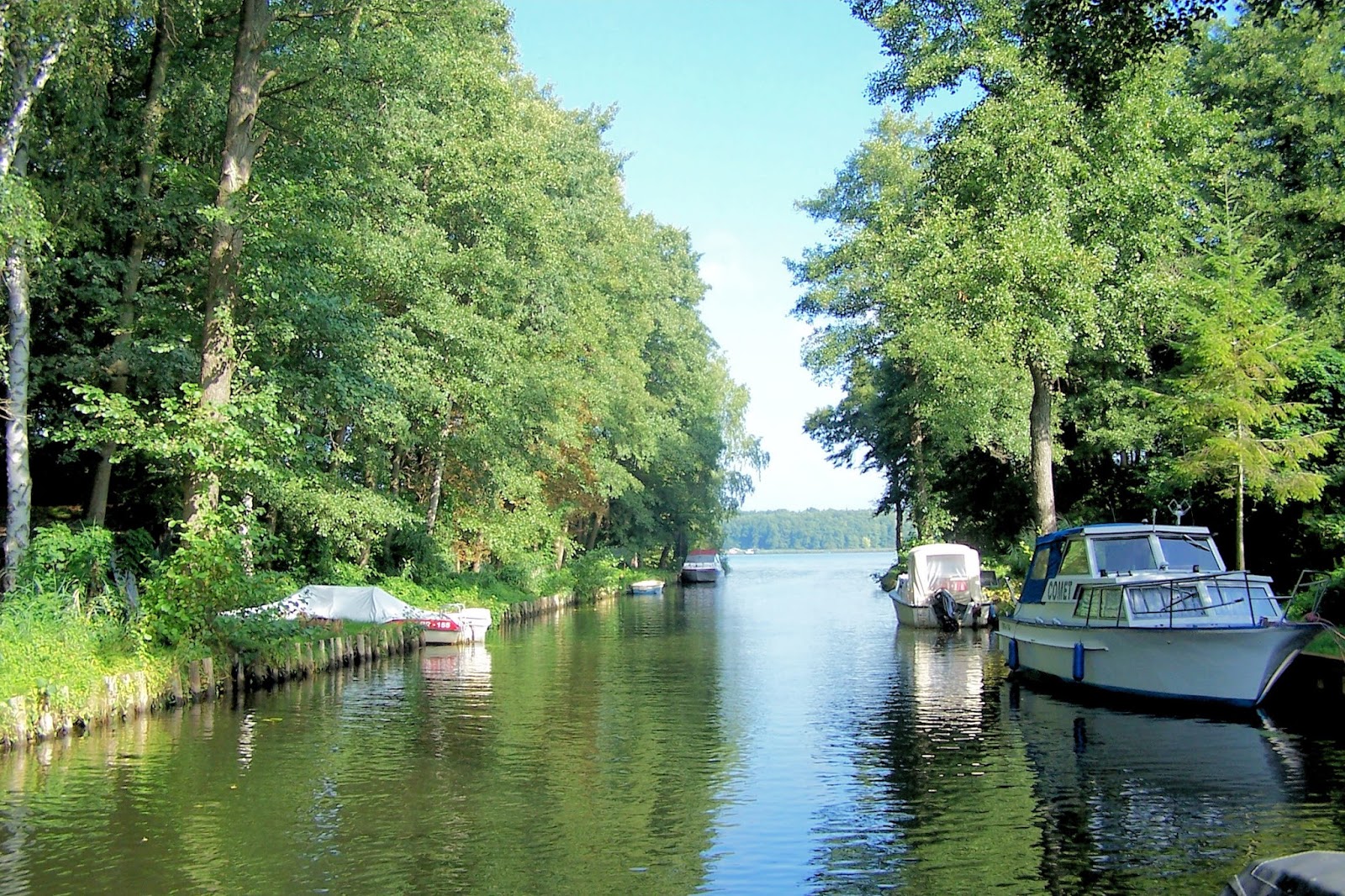
Idyllic mooring at Philadelphia
The wind picked up and produced some interesting waves for the kite-assisted wind-surfers. Once on the Storkow kanal we were soon at the next lock, also ready for us, at Kummersdorf, a rise of 1.2m and then continuing again along the canal. At 4.15 pm we tied next to a wooden-edged grassy bank with stumps, under trees in Philadelphia.

Sunday, 29 September 2013

Tuesday 24th September 2013 Spandau North of the lock to Spandau South 20.8 kms 2 locks


Waiting area abv Plotzensee lock. 
Drizzle that lasted most of the day, becoming heavy at times. Set off at 9.30 a.m. with the generator engaged to do some more washing. Winded and went back North up the lake a short distance to the start of the Hohenzollernkanal, grey and dismal in the wet. At 10.45 am we arrived at Plötzensee lock and moored next to the waiting area – a very inhospitable length of metal tubing whose horizontal bars bore witness to innumerable scrapings of multi-coloured paint from the boats whose fenders were in the wrong places when they tried to moor next to it. Mike pressed the button to call the lock keeper on the intercom and had no reply, the thing was broken. It looked like work was going on in the left hand lock chamber, (the right was out of use), with a WSA boat in the lock and various workmen in fluorescent reflective waterproofs attending to whatever was going on in the lock. 
Leaving Plotzensee lock
A voice made an announcement on the tannoy system, but it was drowned out by the noise of traffic on the road alongside the canal. Mike managed to pick out the words “two hours" and "work” and so we took shelter from the rain for a while. Around midday the WSA boat came out of the locks (it had a blue and white "diving in process" flag on it) and we got green lights. 
Houseboats.
The lock was surrounded with cameras and we deduced that it was remotely worked, from where we had no idea but the gate rose from the murky depths behind us, the chamber emptied and we left 0.9m lower than when we went in. Still raining quite heavily as we ran down to the junction with the Westhafenkanal and I took photos of the houseboats in the corner basin. We turned right and ran along the Westhafenkanal for a short distance then turned left on the Charlottenburger verbindungskanal (link canal to Charlottenburg) dead straight for about two kilometres to a junction with the river Spree and the Landwehrkanal. We intended to take the latter route but found a sign that said “No entry, except boats with engines less than 3.69pk”. We had heard that this canal now had one way working and we hadn’t known which way, now we knew – the opposite way to the one we wanted to go. 
Houseboats. Looking back towards Plotzensee lock
We turned right, heading down the Spree through Charlottenburg and spotted a boat we knew, little Katje, an unusual DB that we’d met up with at Burgwall. We winded and went to moor by the boat hoping we might get more information about navigating through Berlin from the crew until it dawned on us that there was no one on board and this was Katje’s home mooring and no one was going to be on the boat any time soon. We decided to push on to Spandau and take the long way round as we were unsure of crossing through the middle of Berlin without a “legal” VHF Marine radio (with ATIS - our new one is waiting for us at Mum’s). 
Under the autobahn bridge at the end of the
Hohenzollern kanal
Past the gardens of the grand palace of Charlottenburg and on to the lock of the same name. I made a cup of soup to warm us up a bit. There was a large cruiser waiting for the lock. The skipper said about a quarter of an hour. Not long after two commercials came past and went into the lock, filling it, no room for us. I made a hot sandwich for lunch and we almost had time to eat it before the lock refilled and we got a green light. The lock at Charlottenburg had been rebuilt when we were here last in 2004/5 and had a very smart elevated cabin alongside the chamber, however, from the number of cameras surrounding the lock we suspected that this also was remote-controlled. 
Is there a lock keeper up there?
Charlottenburg lock.
We followed the cruiser into the lock and dropped down another 1.1m. The rest of the Spree running into Spandau is a bit grim and industrial made worse by the rain. Past the coal-fired power station next to the huge Siemens factory. The 24-hour mooring in Spandau below Spandau lock was totally empty. We tied up in the rain at 4 pm, two kilometres further South than where we started from this morning. As we finished mooring a Polish Bizon tug pushing two pans of coal for the power station came down Spandau lock. It moored opposite us while the tug unleashed its two pans and ran round to the other end and coupled up again – it was too long to make it round the bend on to the Spree so it did the simple trick of swopping ends. Mike said he was surprised they tied the pans up while they moved the tug, as we’d seen Polish tugs do the same thing with free pans on the flowing river Oder at Eisenhüttenstadt with a skill and timing that was remarkable.

Monday 23rd September 2013 Kremmen to Spandau North of lock. 39.5kms 3 locks

The quay at Kremmen - home for two wet weeks
Grey clouds and later just brief spits of rain. Set off at 6.40 am and went upstream of the road bridge to wind. Ten minutes later we passed the boat that had arrived at dusk the night before and moored in front of us on our way downstream, no signs of life aboard. Spotted a tall wooden hide for hunters that had been blown over and was lying hidden among the trees. A heron kept flying off in front and then a pair of cranes struck up from the field to our left and flew over the boat, calling loudly as they went - no time for the camera. 
A long straight section of the Kermmer Rhin
The tree that had been brought down in the gale last month and had just missed a house in the forest had now been chopped into a neat stack of logs. A crow was busy attacking a white-tailed eagle as we arrived at Hohenbruch lock. It was just 8 am and the keeper came out to work the lock for us. Mike saw a pair of white-tailed eagles flying over the lock as we dropped down in it. Not far below the lock we passed a most unusual little sailing boat with moveable outriggers. It was sitting in among the lily pads and its skipper waved and said "Morgen" as we passed by. 
Hohnebruch lock
Not sure if it was anchored or not, maybe had wind-down legs like the sheds have. Into Tiergarten lock for 9 am. Same chatty keeper, he wanted to know if we liked Kremmen, so either someone told him we were there or he must have driven past and seen the boat moored there. He laughed when Mike took photos of a vole sitting on his lock gate. Then as we were leaving two pairs of ducks flew low over the boat and, fearing a bombing run, we both ducked, laughing, as was the keeper. 
Vole taking a break on the lock gate. Tiergarten
At the junction with the Oranienburger kanal there was a notice that said “Munition Beratung” – ammunition?? And there were three men in a small metal pontoon doing something in the water. Hope it wasn’t live WWII stuff! The canal was deserted, no boats, but we saw a child minder walking with a strange box on two wheels containing four toddlers who couldn’t be persuaded to wave back to the funny man on the funny boat. Little beaches along the canal that were full of swimmers and sunbathing youth in the summer were now empty. A lady walking her Alsation dog stopped to wave and say hello. 
Below Pinnow lock. Oranienburger kanal
The quiet lock keeper worked Pinnow again for us and at 11.10 am we turned right on the Oder-Havel-Kanal and started looking for a drinking water tap. The first place was an offline basin and the first boat we’d seen moving was coming so we slowed down so we could have a look and maybe turn into the arm. No good. There was just a small channel between houses with stumps to moor boats to, but none there, and no tap. We carried on down the Havel. Fifteen minutes later our second boat of the day went past, a smart charter boat. 
A private, palatial, floating shed.
We found a landing to tie to at the Marina Havelbaude. No coin operated taps and so Mike went to find someone in charge and paid 2€ for our 300 litres. While he was away I filled the kettle, made a cuppa and did the washing up. We set off again at 12.15 pm with the big gennie running to do some washing.  Finished just before we had done the length of the Havel lake leading to Spandau. The quay was empty so we had our choice of mooring. It was 2.25 pm. 

Wednesday, 18 September 2013

Photos of the moorings between the lakes at Lindow


Bored. Not moving as the weather has turned nasty, rain and more rain. So here are some of the photos I took of the moorings in Lindow as we went from the Vielitzsee towards Gudelacksee.


North end of the Vielitzsee where it narrows coming
into the town of  Lindow
Holiday bungalows have moorings for small boats
And bigger boats have boat houses
More boat houses
A chalet with a long offline mooring
More boats and boat houses,
more like car ports than garages
Under the road bridge looking towards the railway bridge in Lindow
Boats moored beyond the railway bridge
More bunglaows and a little slipway
Bridge over access to offline basin
Sailboats as we get nearer the big lake
Slipway for sailboats
Another old boat house and bridge
Modern bunglaows
Getting nearer to Gudelacksee

Another bridge over access to an offline basin

New boathouse

Charter boats


Offline basin with a tent and caravans
Smaller boats moored in the shade.

An old communist era boat house
End of the channel to Gudelacksee
View of Gudelacksee
A Bunbo cruising across the Gudelacksee