Translate

Tuesday, 7 May 2013

Monday 6th May 2013 Ampsin to Visé. 44.5 kms 3 locks


It's a lovely day, can't we go out to play?
Sunny and warm, cloudy after lunch and the wind picked up late afternoon.  Set off out of the weirstrean at 9.30 a.m. Mike called the keeper at Ampsin-Neuville to ask if we could use the small chamber (this lock has two chambers side-by-side) He answered saying “La Neuville, bonjour” but didn’t reply to Mike again, so maybe he wasn’t talking to him at all! We waited above the big lock (looked like they weren’t using the small chamber) while two Dutch cruisers came up, then we went down. A shaggy dog was standing with his chin on the window ledge of an open window in the lock cabin up above us, sunbathing. 
Below Ampsin-Neuville lock and weir
Bolero (formerly Mureen – embossed on the bow, but painted over) an empty Dutch boat from Terneuzen (95m x 10.5m 2,412 tonnes) was waiting below the lock. As we left the lock and ran down to the end of the high walls that form the lock entrance we looked back at the weir and were surprised to find that today it there was no water flowing over it, just the occasional wind blown splashes. Downriver the high concrete quay walls eventually gave way to sloping concrete with derelict land beyond on the left and houses of the town of Amay covered the low hills beyond, while on the right there was a busy road. 
Cement works at Engis
A cruiser was moored behind the Ile des Ponthieres on the non-navigation side next to a high quay wall. A small tug boat from Oostende came upriver to a work boat where there was a crane and a stack of metal piles lying on the bank. A boat with a series of round tanks in its hold came past, specially constructed for carrying bulk powders like cement. The port at Hemalle was busy. Another cement tanker boat called Aletta (67m 7.23m 892 tonnes) was being loaded by tanker lorries; Romania-B (105m x 9.5m 1,910 tonnes) was unloading gravel, 
18th century Chateau de Chokier
while Target (63m x 7.09m 700 tonnes) was waiting to unload his cargo of gravel. Sandpipers flew along the river, oblivious of the heavy tonnage boats. A loaded boat called Nomadis from Brussels (80m x 8.22m 1,143 tonnes) went past heading uphill with a Dutch cruiser following it as we passed the end of the port. Took photos of a little shunter engine pulling cement wagons at the cement works in Hemalle and photos of the big cement works in Engis. Up on top of a crag there was a derelict chateau at Chokier,  on the opposite side of the river to a bustling port in an offline basin at Ramet. 
German boat loading coke. Seraing
As we approached the lock at Yvoz-Ramet we were overtaken by two loaded commercials as we waited for three Dutch cruisers to leave the lock. Lots of work was going on above the lock where it looked like they were building a bigger new lock, or maybe two side by side. Filos, a big Dutch boat from Rotterdam went in first on the right, followed by Sesanda, a smaller Belgian boat, who tied on the left as there wasn’t enough room left for him to lie opposite the first boat. We went in and hung on a lock ladder with inset bollards on the right while the Snail got swept alongside Sesanda by his prop wash, 
Sunken boat by Cotterill's blast furnace. Seraing
so they tied alongside the barge. Contrary to the regulations (and big notices that state the regs – all boats must stop propellors and engines and have ropes at bow and stern) the latter had only one rope out from his bows and kept his prop turning to keep his stern against the wall all the time we were in the lock. This had the effect of creating an anticlockwise whirlpool that pushed our stern out off the right hand wall, which Mike had to attend to a couple of times by starting up the engine and powering the stern back towards the wall while I moved our centre rope down the bollards as the lock emptied. 
Clouds of dust. Seraing
We followed the big boat, Filos, and the Snail out of the lock to give Sesanda room to power his stern off the lock wall and move out of the lock chamber. Two empty péniches, Haydes and Follow Me, went into the lock we’d vacated, followed by DB Andante and a small Dutch cruiser. A Belgian boat called Faraday (110m x 11.45m 2,804 tonnes) was unloading coal at the quay immediately below the lock, while Dutch Hydra2 was waiting to unload next to piles of soil. Pan and tug Laco9 (64.67m x 8.36m 1,995 tonnes) was waiting to unload his cargo of sand. A string of empty boats went past heading uphill, A Dutchman with no name (new paint) (86m x 9.5m 1,272 tonnes), Cupidon (105m x 9.5m 2,303 tonnes) Saron-K (80m x 9m 2,213 tonnes). 
Sculpture by the Science Musuem in Liege
It was very choppy between the walls from the wash of the boats (staggering about making sandwiches for lunch was interesting as the boat bounced through the waves). As we passed the coking plant and Cockerill’s blast furnace at Seraing, a boat was loading coke and just downstream, in front of the blast furnace, there was a sunken boat surrounded by red markers. Railway wagons along the bank were loaded with steel coils. A Dutch cruiser went up river. A boat loading with coke from tipper lorries kept disappearing in clouds of thick black dust. Further down the quay they were loading something that was kicking up great clouds of white dust. The wind was starting to pick up, blowing directly in our faces, but at least it wasn’t cold. 
King Albert memorial at the start of the Albert Canal
The already high quay walls had been extended upwards by new flood defences downriver to the new suspension bridge. A square tug called Remover went past flying a skull and crossbones flag. Into Liége, under the ornate Pont de Fragnée and past the lock leading up on to the River Ourthe, we turned right by a fountain to investigate a mooring suggested by Anne and Olly's friend Dick. By the rowing club and a park the concrete edge had bollards for mooring. Unfortunately the vertical concrete was on top of an old sloping stone wall, so we couldn’t get near enough to the wall to moor. We moved to the lower quay by the canoes and Mike and Anne went to check the access. There was a fence with a gate into the park and a sign that stated opening times. Hmm, might go out and not be able to get back in if the gate was locked. Decided against mooring there as we were still bouncing about in the wash from passing traffic even though we were not in the main channel, it was 2.45 pm when we set off again and carried on downriver through the city. A police boat (an RIB with a big outboard engine) went past as we pulled out of the arm. 
Petrol barge going down Monsin lock
Took photos of the amazing metal structure next to the Palais de Congres. Seven Dutch barges and converted péniches were now moored on the outside wall of the Port-de-Plaisance, plus a big trip boat. Tall blocks of offices and flats with shops on ground floor level lined both banks. An ex-Amsterdam trip boat set off, with a roar from its big diesel engine, from the low quay at the bottom of a flight of steps leading up to the science museum. Just beyond that was a green (copper) sculpture of children playing leapfrog (we’d seen one exactly like that in East Germany) as Synthese2, an empty Dutch tanker boat went past heading upstream. There was a long line of houseboats along the right hand bank, mostly converted péniches. 
Lock filling valve at Monsin lock
An empty boat called Keale went past (about 750 tonnes) as the police boat dashed past us again heading downriver and came back again not long after. A big pan (90m x 1.45m 3,400 tonnes) being pushed by a big tug called Nada from Antwerp, went past us heading uphill as we cruised past the memorial to King Albert at the start of the Albert canal – the river flows over a weir off to the right. We paused at Neptunia's fuel barge to top up our central heating tank with 100 litres of red diesel. While Mike was filling up, Oll and I went on board into the chandlery. They had no cord suitable for fender string that I wanted, but Oll wanted a small European flag so I bought one too and I paid for the diesel and the flags by card. (Later I looked at the bill and found the flags were 15€ each and the diesel with two lots of extra tax on top, besides VAT at 21%, was 0.9754c per litre for such a small quanity) We chatted with the two guys on the barge about where we were going, as they seemed very interested, until a loaded Dutch boat called Sijtje arrived and wanted to come alongside for fuel, so we set off again down the Albert canal, past the docks to the lock that leads back on to the river at Monsin. 
Moored on the river Meuse at Vise.
Mike called Monsin lock and got a green light, but as we approached the light turned to red. We tied to the wall while loaded Dutch petrol tanker Velocity (125m x 11.45m 3,400 tonnes) reversed down the lock approach and into the lock chamber. The lock keeper came down from his cabin high above the tail end of the lock to tell us that he had to give priority to the commercial. That was OK, we understood and appreciated that and it was nice of him to come and tell us. He also informed us that the VHF channel had changed to 20 and was no longer 14.  The big boat went down the lock backwards as there isn’t enough room for him to wind on the river below the lock. He left the lock and then went forward a short way upriver to unload at the oil terminal in Monsin. The keeper refilled the lock for us and we dropped down 5.7m in the huge lock chamber. It was 5.25 pm as we left the lock heading downriver on the Meuse. Wind in our faces again and getting colder, fleeces back on. 9.5 kms of river to Visé. Past the remains of the old lock at Hemalle – just one lock wall and an old lockhouse among the trees - and a long sand quay above the bridge at Hemalle-Argenteau; we didn’t think they brought sand there by boat any more. The motorway runs along the right bank close to the river all the way into Visé and as we approached the town Mike spotted a great cloud of dust as a gawping lorry driver watching us almost drove off the motorway! We’re a road hazard!! It was 7 p.m. when we moored on the quay wall on the right bank, opposite the access channel to the lock at Visé, where we have always moored in the past, and decided not to stay there this time because they charge for moorings now and because the banks were full of geese, standing room only, which meant the path would be full of goose dung and would stink. Our quay was almost roof height, but beyond it was a big area of grass and trees, ideal for Woody, and the motorway had swung away from the river so it was less noisy. A bit further upstream from where we’d moored was a slipway and a small speedboat went up and down until it got dark, so we were still bouncing around – but it stopped and we had a peaceful night.

Sunday, 5 May 2013

Saturday 4th May 2013 Sclayn to Ampsin. 22.4 kms 1 lock


Spoetnik's barge and bunkership - for sale
6.8° C Clear blue sky, warm when the wind wasn’t blowing. Untied at 9.15 am, winded and set off downriver. Happiness from Brugge (105m x 9.5m 2,51 tonnes) loaded with coils of steel wire went past us and we followed him into Andenne lock, he tied on the left hand side, we went on the right with the Snail behind us. The big barge just fitted into the top half chamber of the lock and the lock keeper asked him to move a metre further down the lock to clear the top end gate. 
Tope end gate rising. Andenne lock
The gate is hinged on the floor of the chamber and is swung into position with cables, the railings along its top edge emerge from the water like a surfacing submarine. Two small children were playing around the cabin and in a big playpen that was secured to the sliding hold cover nearest the cabin. The lock emptied slowly but we were soon under way again. The skipper called us to go out first. He soon overtook us. The next uphill boat was hovering below the lock and was followed by an empty called Corteo-G from Antwerp. We followed Happiness past the Ile Dosais through Andenne. High quay walls lined both banks. The chantier naval at Andenne was deserted, not a boat in sight and nothing on the slipway. 
Leaving Andennes lock
A Dutch cruiser went past heading upriver closely followed by a German-flagged mini-tjalk (they build new ones now in the Netherlands as there aren’t enough old ones to meet demand) very smart. As we passed the big silo quay by the Ile des Beguines, another Dutch barge went past heading upstream. As we went past the island two commercials went past, Keistadt, a 750 tonne Dutchman carrying sand and a 47m empty French barge called Galway. Just after the island the high quay walls came to an end and the banks were sloping earth and rocks on the left and sloping stone with steps on the right. 
These are mobile banks! Andenne
An empty French thousand tonner called Humadivi went uphill, then a Belgian cruiser. A Dutch empty called Falaise (cliff in French) 1022 tonnes went past making lots of wash at Bas-Oha where there was an unusually big group of ten swans. Past Ile Bosquel and Ile de Sucrerie and the sugar works at Wanze. A big tanker boat with an inverted blue cone at either end, called Riad from Woudrichem (110m x 1.45m, 2,791 tonnes) was moored at the sugar works quay just upstream of the big suspension bridge. The next boat past was the heaviest Anne and Olly had seen to date, Graafstroom from Ridderkerk (108m x 11.4m 3,594 tonnes). 
Deserted chantier naval at Andenne
Wanze basin was now filled with boats and called Statte Yacht Club. Round the next bend and we were cruising through the historic city of Huy. Its cable car to the citadel was not in use, the gondolas were missing. Shops and houses lined the right bank and a line of five converted péniches lived on the left bank and 1000 tonner called Aladin was moored with them. Nowhere for visiting boats to tie up, there were “No Mooring” signs all the way through the town. A sand quay stretched along the right bank as far as the nuclear power station at Ampsin. 
The sucrerie quay at Wanze.
A sign at the end of the sand quay stated that the depth was 2.5m for 469m (the length of the quay) in the middle of the river it was six to seven metres deep. We noted that the power station now had enormous double layer security fencing with razor wire, cameras and lights. We motored on down the weir stream to the left of the lock at Ampsin and found a convenient place to stop right next to the car. In front of us was a péniche called Neptunia, which was for sale. It was 12.40 p.m. 
Ampsin power station
We had sandwiches for lunch then Anne came with us to do some shopping at Carrefour in Flémalle, 20 kms down the road towards Liége. Prices seemed more expensive than France. Called at a Brico on the same site. I bought some flowers for the pot on the roof, Anne didn’t see any she liked – they didn’t have much choice. Mike wanted a lump hammer (not at 26€) and a spanner (got none) but he found some gloves to use in the car for keeping the seats clean when he has to move them to get the moped in the back.
Moored in the weir stream at Ampsin.

Friday 3rd May 2013 Anhée to Sclayn. 35.3 kms 5 locks


Weir at Hun lock
10.7°C Grey and raining first thing. Rain had stopped by the time I’d finished the blog and we moved off at 10.15 a.m. We passed the first cruiser heading upriver ten minutes later. The lock at Hun was ready with gates open and a green light, so we were in, down and out in no time. Took photos of the weir from below, surprising how much water was being let through. There were more climbers on the rocks below the weir. We went past Allonso (857 tonnes 67m x 8.2m) who had been unloading in the port of Givet and who was now being loaded at a quay from a succession of tipper lorries. Below Hun the reach to Riviere was bordered by some very fine properties, elegant detached houses in beautifully manicured gardens.
Sharing Riviere lock
At Riviere we had to wait for an empty commercial to come up, waited until an empty commercial called Inattendu arrived and went into the lock, then we followed him in. I made bacon sandwiches for lunch with bubble and squeak, which we had plenty of time to eat on the 5.4 kms run down to Tailfer. About a kilometre before the lock Mike stood on the roof of the boat to take a photo of a swimming pool fashioned to look like a ship. We had to wait at Tailfer while Inattendu cleared the lock, the keeper refilled the it and we went down on our own. Lock houses for the keepers on this river come in pairs as the locks are open long hours so there are two keepers to a lock, but the one at Tailfer was a large single white building that had had many extensions added to it over the years. 
This is a swimming pool
The keeper on duty was keeping watch over his bottom end gates while we locked down. As we left we saw the reason why, a huge log - bigger than a canoe, was sat right outside the gates and looked as if it would drift into the chamber as we left. There were many more expensive properties along the river and several beautiful Châteaux around the Ile de Dave. We passed an empty commercial called Pegase heading upriver. Had a text from the Snails to say that they were moored in Namur on the Sambre close to the junction with the Meuse and asked if we’d check the mooring by the Casino, which is just below La Plante lock. Not long after, we locked down La Plante and asked the keeper where the best place for us to moor was and he said by the Casino. 
Chateau by Ile Dave
What he didn’t mention, of course, was that the charge for tying up to the bollards on the old stone quay opposite the port-de-plaisance would be 8€ per night with no facilities. No thanks. We went to have a look at the moorings where the Snail had tied up. No other boats were moored along the Sambre in Namur, ominous. We winded to moor in front of the Snail and said hello to Anne and Olly. There were no “No Mooring” signs but it didn’t look very good, so we decided to move on downriver to see what Dick’s mooring looked like. Anne said Dick was still on holiday in Portugal and anyway  his boat was not in its usual mooring due to work being done there, so no chance of mooring alongside him.  It was 3.40 pm as we untied again and a big boat loaded with scrap called Play Boy (1,416 tonnes and 85m long) came up the Sambre as we were heading down it to the junction. 
Dick's boat is the white tjalk with mast
We continued down to Grands Malades, passing Amateur (another 85m boat) tied up and looking abandoned among the houseboats. Natacha had just come down the Sambre and was now moored above Grands Malades and unloading their car off the deck with their crane. The lock lights were red. We waited while an empty locked up then followed another empty, called Benita from Brugges, into the chamber and tied on the opposite wall. The keeper called Mike on VHF and asked us to move right down into the half lock – we hadn’t noticed that Benita was in the lower end of the lock. 
Waiting above Grands Malades
On down the river. Another empty, called Lady Night, went past heading upriver making a lot of wash, we bounced about for half an hour afterwards. A loaded Dutch boat painted yellow and purple called Tesco3 went past heading upriver. We moored on the wall where Spoetnik used to be at 6.15 pm. Spoetnik was a fuel depot and had a chandlery shop in a moored boat. Tragically, some years ago, it set on fire and all was destroyed, not to be replaced. Olly gave Mike a hand to unload the moped up the wall onto the quay and Mike went to move the car on to Ampsin, so we could all go shopping from there the following day.

Friday, 3 May 2013

Thursday 2nd May 2013 Givet to Anhée. 28.6 kms. 6 locks


New floodgates at start of lock cut. Givet
Grey overcast start, but no wind, sun coming out later. Mike fetched some bread while I used the Internet on Bouygues for the last time and finished off the blog. Then I rang the customer services line of SFR to cancel the phone, which isn’t on a contract. Easy but the woman wanted to speak to Mike as it was his account so I had to take the phone out on the stern for him to answer security questions, as he was steering and we’d just passed the weir and entered the lock cut through some impressive new flood gates and after passing a Dutch cruiser heading upriver. We could hear commercials calling on Channel 10 VHF as we ran down through the port. There were heaps of scrap metal, coal and pig iron around the docks. 
Smart new lock cabin at Quatre Cheminees
One large boat was unloading in the middle arm of the three, the third one had cruisers moored and out on the hard on one side of the arm, the other side was used for loading and unloading boats. It’s good to see the port being used, never seen much in there before. A Dutch boat called Battello, 46m x 6.3m 378 tonnes, was waiting to be loaded at the silo as Renata, a 1000 tonne Dutch boat was completing its loading with grain. The skipper shouted “Nice narrowboat!” in English as we passed. Beyond the silo there were several more boats out on the hard including two catamarans, one was having its bottom anti-fouled. The noise of military jets taking off nearby was very loud. Lock 59, Quatres Cheminées, was our last lock in France, now with a new cabin for the staff. 
Belgium's weirs are modern. Hastiere. River Meuse
An empty 750 tonne commercial called Inattendu was coming up in the lock chamber (100m long x 11.40m wide to conform with the Belgian locks as far as Namur) with a cruiser tucked in behind it. I took our vignette down to the lock keeper. The young man in charge was very pleasant and surprised when he asked where we were going and I said Berlin. I’d forgotten the telecommand, but he said he’d collect it when we were in the lock. The commercial left, followed by a Belgian cruiser from Waulsort (the boat club below the next lock), then we went in. Gave the keeper the zapper and we said au’voir France. Mike held the “string” while I made a cuppa. 
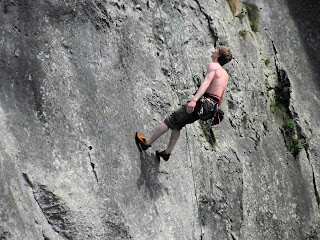
A climber on the Roches de Freyr
The border was just a couple of hundred metres below the lock and our favoured place for collecting a tankful of red diesel (before they changed the law and Belgium, like the UK, lost its derogation) Monsieur Léonard’s shop and fuel supplier. The place looked quiet, no boats stopping to fill up now. Another Belgian cruiser went past heading for France as we arrived at our first Belgian lock, Hastière, and noted that the weir above the lock was a modern, automatically operated affair with three big radial gates. An empty péniche called Ares was moored above the lock and a German cruiser with navigation lights on was coming up in the chamber. The red light changed to green and we entered the big chamber, just us. The keeper came over with a piece of paper. No more quittances we said and he said no, not any more and I looked at the paperwork – he already had all our details and the route down to Lanaye! Belgian efficiency, wonderful. All done from just the boat name, which brings up our Belgian MET number (because we’re on the computer, having been there before). 
Roche a Bayard. Dinant
Yippee, no more getting bits of paper stamped and having to climb back down mucky lock ladders to get back on the boat as the lock was emptying because there were commercials waiting. It was just midday as we left the lock heading downriver. 4.9 ms to the next. Took photos of the château and church at Hastière-par-dèla about a kilometre below the lock. Some very smart houses lined the right bank while a busy road and a disused railway followed the left bank. The low forested hills started to close in again as we approached the lock at Waulsort. An invisible keeper this time, the lock was ready and we were in and down in no time. I made sandwiches for lunch on the long reach (7.2 kms) while Mike took pictures of the boats moored at Waulsort boat club and then climbers on the Freyr rocks. A couple of Army trucks and an inflatable boat were parked on the left, opposite the rocks and just before the Château Freyr with its beautifully laid out gardens. The sun came out and suddenly it was much warmer but a bit breezy. A canoeist caught us up as we finished eating lunch. He paddled alongside asking questions, in French, then realised we were English – he thought we were Flemish from our accents! A line of eleven cruisers were moored at the boat club in Anseremme. The lock at Anseremme was ready for us and the keeper leaned out of his window to wish us au’voir as we left. Below the lock was a long line of green and red marker buoys indicating the old wall between the end of the old lock and the island. 
Dinant
A boater we met in Fumay when we were stuck there during the floods had sunk his boat by grounding on the submerged wall, he didn’t realise his boat was on a wall and thought he had stuff on his prop, removed the weed hatch and a passing commercial sank him by flooding the boat through its weed hatch, traumatic to say the least, but he’s still boating. Mike took loads of photos as we went through Dinant. The little blue electric hire boats were doing a good trade, as was the former Amsterdam tripper. The town was busy, as always, with tourists. The tariff boards told us we would pay 18€ per night to moor there, (that's £15.25 per night!!) so no thanks – the first lot of pontoons were empty. A lone retired péniche, called Remacum, was moored at the quay upstream of the trip boats. A brand new Ibis hotel and Casino had been built next to the main bridge since we were there last. On beyond the bridge there were two large Dutch cruisers moored on the pontoons. The lock at Dinant was full with a red light on. We waited above for Renata to arrive (he was the boat loading at the silo in Givet) as he went into the lock the skipper called us to follow him into the chamber and we went down together. 3.4 kms to the next - we had no hope of keeping up with him as he was doing twice our speed. 
The quay at Anhee
It was very noisy with the sounds of military jets again, but this time we could see them flying over. Below Dinant lock there were houses crammed into the limited space between the rocks and the river, then the space opened up and there was a campsite on the long right hand bend. We went to the left of the island as indicated on our guide book, but we think the commercial went down the right hand side – there were no notices any more to say which side to take. Renata was going down in Houx lock when we arrived so we tied up and waited for the keeper to refill the lock. A small dayboat with a large outboard arrived and came into the lock with us, it was a bateau ecole – a school boat – in other words someone was having a “driving” lesson. It sped off into the distance as we rounded the next bend and moored on the quay at Anhee at 4 pm.

Thursday, 2 May 2013

Tuesday 30th April 2013 Abv Vanne-Alcors lk to Givet. 21.6 kms 6 locks 1 tunnel


Mooring we didn't stay at - Haybes
3.1°C Grey, cold and windy, with sunny spells later. Midges everywhere and noisy Canada geese. Set off at 9.30 a.m. in reverse to zap the post. A VNF man-in-a-van drove past and waved. Lock 53 Vanne-Alcorps was full already, the gates opened and we went down on to the 3.24 kms reach. Back past the mooring we didn’t stop at the day before at Haybes. A pénichette had joined the Dutchman and the boats for hire. Off the river and into the short lock cut leading to lock 54 Fépin. We were right the day before not to try mooring further down the short lock cut above lock 54 as there was nowhere to moor at all. 
Vireux-Wallerand - empty moorings
A red squirrel was performing acrobatics in the pine trees next to the lock house. I made tea and toast on the next reach (5.34 kms). Mike was having trouble with the wind making his eyes stream so he found his wrap-around sunglasses out and that helped a lot. No one about at lock 55 Montigny and a large new Danish cruiser was just leaving the lock chamber coming towards us. The grassy banks beside the towpath were full of ladysmock and cowslips. Down the lock while two Dutch cruisers waited below to come up. 3.96 kms to the next lock. No boats were moored at the extensive (pay) moorings at Vireux-Wallerand where they had now erected a new sign
VNF men-in-vans. lk 56 Mouyon 
saying that commercials were forbidden to moor. We passed another Dutch cruiser heading uphill. At lock 56 Mouyon there seemed to be a great gathering of VNF men in vans, six of them with three vans, chatting by the top end gates. They left as we started locking down. Below the lock they’d built a new overnight mooring place for péniches consisting of three dolphins with two passerelles to the bank. (Our VNF-man-in-a-van had said it had cost the VNF around 250k€ and he’d never seen a péniche moored there overnight). 4.76 kms of very windy river to the next lock. 
Peniche mooring below Mouyon
The sun shone timidly for a while. A colony of Egyptian geese were grazing the meadow to our left where the steep hills had now become smaller and more distant from the river as we ran along the foot of steep forested hill along the right bank. The wind was blowing half a gale as we passed Aubrives on the left bank and its row of stark white modern sculptures. Under the liftbridge into the lock cut leading to the two locks and a tunnel, which cuts off a very long loop of the river. Although there was a box to zap, lock lights and control rods in the chamber walls, both locks were worked for us by a new VNF man-in-a-van. 
Liftbridge over lock cut at Ham
The van was already on the lockside at lock 57 Ham and our man was in the cabin working the lock for a Belgian cruiser. Once the cruiser had cleared the lock we went down. Noticed that the sensor to detect boats entering or leaving the chamber was suspended high above the bottom end gates (they’re usually in the ends of the lock walls). Through the 565m long tunnel at Ham, it didn’t have lighting, (unusual for French tunnels) and into lock 58 Trois Fontaines, which was ready for us as our man was in the cabin, waiting for us. Below the lock Mike’s case for his sunglasses went for a swim, whipped off the roof by the wind, so we did a demi-tour and managed to pick it up before it sank.
Power station at Chooz
 The cooling towers at the Chooz nuclear power plant were sending wisps of steam into the sky to join the other light fluffy white clouds. Past the slate quarry and the citadel and moored on the quay at Givet at 1.30 p.m. with DB Stella Maris moored a few metres further down the quay. Both banks of the river had been altered for flood defences and there was no sign of any pontoons on the far bank that formed the port-de-plaisance. 
The quay at Givet
Maybe they’ve moved it to the safer location of the old commercial docks in the lock cut leading down to the last lock in France at Quatre Cheminées.
Power watering the flowers. Givet

Wednesday, 1 May 2013

Monday 29th April 2013 Bogny to abv Vanne-Alcorps lk. 43.5 kms 8 locks 1 tunnel


Mist hanging over the river
2.5°C Foggy start, cold and windy, sun out later in the morning. Mike was woken at a quarter to seven by a solitary forge hammer warming up in the factory across the river opposite the moorings. It reminded him of the moorings, years ago, at Barker’s yard Tipton with the now long gone Buller’s forge across the canal. It was still misty when we set off at 9,15 a.m. Still no signs of life on the German yacht as we left. The sun was out, burning off the mist, but we still had a cold north wind in our faces much of the time. Surprised to see that work was in progress at Monthermé to build a new quay for mooring, with bollards and water and electric. 
Montherme
Let’s hope they remember to dredge it as only round bottomed cruisers could get anywhere near the rough, grassy bank to tie up before. The noise of forge hammers could be heard as we passed through the town, it was coming from some old industrial buildings. By the time we reached the next lock the sun was shining from a clear blue sky. The needle weir at Monthermé had been replaced by a new modern automatic device. Into the long lock cut leading to lock 46 Monthermé. A pair of ducks were flying off in front of us for around 20 metres then landing, waiting for us to get closer then flying off again. 
Female merganser
I took some photos from the front deck of the female merganser – the male had flown over the boat and gone behind us. A tractor with a special rotating sweeping brush went past us down the towpath/road/cycle path, with a van behind it that had yellow flashing warning lights. The sweeper was kicking up a lot of dust. Down the lock and on to the 4.2 kms reach. A VNF man-in-a-van drove past heading for the lock and waved. When we arrived he was in the lock cabin. We continued as normal and Mike lifted the rod. The VNF man-in-a-van drove off down the towpath. 
Forge at Deville
When we left the lock Mike noticed that the gates didn’t close behind us. Took photos of a working forge just below the lock in Deville. A little further down river Mike took a photo of the tall house that used to be an hotel, now sadly dilapidated, just past the island in the river at KP 52.5. Two more Dutch cruisers went past heading upriver as we entered the lock cut leading to 47 La Commune. No lock house at this one and the grass around the lock was a carpet of mauve ladysmock flowers. 4.59 kms to the next. Another uphill boat, a Dutch barge called Ysselstein with a British flag. They shouted “We’ve got one of those at home!” and were gone before we could reply “So have we”
Lock 47 La Commune
As we entered the lock cut, the wooded hills to our left were named the famous Rochers des Dames de Meuse, they represent the unfaithful wives of three knights, that were turned to stone. The trees between us and them didn’t allow any good photos. Another large cruiser was coming up in lock 48 Des Dames de Meuse, when it cleared we went down. On the next reach, 4.73 kms long, I made us a cup of soup as we were getting chilled to the bone with the constant, and at time ferocious, North wind in our faces. Mike put his coat on and muffled up against the wind. 
Lock 48 Des Dames de Meuse
Strangely, we had to wait while lock 49 Orzy filled. A backpacker walking the towpath passed us as we locked down. We passed him again as we went down the short (1.6 kms) reach to Revin. The short tunnel (224m) leads to lock 50 Revin, which always used to be keeper controlled, but now is automatic like the vast majority of the rest of the locks on the river. This link cuts off another of the Meuse’s crazy circular loops. A long pound followed (6.1 kms) which gave me time to make some sandwiches for lunch. There were two VNF men-in-a-vans at lock 51 St Joseph and a Nicholls hireboat from Pont-à-Bar in the lock. 
Needle weir at lk 49 Orzy
The two vans drove off as we approached the lock. Zapped and got a red and green light, followed minutes later by double reds – en panne! Nowhere to get off and so Mike put the bow fender on the end of the lock wall and I climbed off over our bows and through a metal barred fence. As I glanced into the lock I saw the hireboat was still there as the bottom gates hadn’t fully opened. I pressed the button on the intercom on the wall of the old lockhouse. One VNF man-in-a-van returned (no one answered the intercom) and he said “C’est le bois!” 
Marsh marigolds abv lk 51 St Joseph
It’s the wood. He took a grappling hook on a long length of rope out of the back of his van and I followed him down to the bottom end gates to see if he needed any help. He seemed well used to moving logs out from behind fouled gates. We chatted as he worked. I said it was sad to see the lock house empty as I remembered the lock keeper who lived there when all the river locks had keepers and they were worked manually. He said that the house had been renovated for a retired VNF man to live in but then they had a tempest, which blew the roof off, so he left. The roof had been replaced but not the tenants, he said they would find a new tenant soon.  
Hire boats below lk 51 St Joseph
We were talking about the VNF wasting money and he said yes they spend it drip by drip and told me that they’d spent a fortune (about 250k€) to build a stopping place for péniches a bit further downriver, but he’d never seen anyone use it. Told him we were going to Berlin then Poland, which sparked an interest. We carried on chatting when the hireboat left and he refilled the lock for us. We carried on downriver, 2.75 kms, to lock 52 L’Ulf. The automatics worked OK until the gates partially opened, and stopped! The yellow lights flashed to say they were opening and stopped again. There was enough of a gap for us to get through so we left it, flashing and stopping - the VNF will get back to it. 
Backs of houses at Fumay
Round the loop of the river that virtually encircles Fumay (4.75 kms) passing the port-de-plaisance, where we once spent a very fraught month when returning to Champagne (after a summer spent exploring some of the Dutch canals) while the river was in a serious state of flood - we were very late that year mooring up for winter. One Danish cruiser was moored at the port plus the Nicholls hireboat that had been stuck in St Joseph lock. Another cruiser went past heading uphill as we passed the wood yard and we had to wait for lock 53 Vanne-Alcorps to fill with another boat in it -  then a little Belgian yacht from Gent went past, crew waving, and we went into the lock and down. 
Swallows taking a rest on lock gates at 52 L'Ulf
Clouds were gathering, great grey ones, but no rain had been forecast. One kilometre downstream of the lock we winded and came in to moor against the new quay wall at Haybes. A smart Dutch cruiser was moored there and the lady from it came to offer a hand with the rope, which was nice of her but not needed (over the years I have learned not to trust anyone with my ropes, no matter how well intentioned they are they ALWAYS have to pull on it or tie it to something – and we don’t moor like that – Mike brings the boat gently alongside, parallel to the bank (unless there’s a strong flow) and after a touch of reverse we both step off with ropes. 
Boats moored at the Port-de-Plaisance at Fumay
If I let someone have the bow rope before I’m within range of stepping on to the bank and they yank hard on it – it pulls the bow in which means the stern goes out, then we have the performance of either tying it down at the bow or loosing it back out so he can power the stern back in – it’s MUCH easier if I do it myself, especially if I don’t speak the same language as the person offering to take the rope!) We tied to the bollards and went to look to see how much they were charging for mooring now the old fallen down quay wall had been replaced. Ominously, the Dutch hadn’t connected to the electricity and I noted that there were padlocks on all the water taps. 
Hydro-electric generating station abv lk 53 Vanne-Alcorps
Mike walked up to the new Capitainerie at a house just off the square. It would be either 6,50 or 8,50€ per night, he couldn’t tell in which band they would class us, probably the most expensive. We decided we didn’t need water or electric or a fancy quay (they had a wooden shed at the end of the quay, where a very bored looking lady had several electric dayboats for hire). Two young men on Segways went past. That looks like fun. As we went on downriver we saw their van – Arden’Gyropodes – training and machines to hire. When we arrived at the next lock cut, having seen nowhere to moor except for dead trees along the meadow (our famous Polish moorings were bows to dead trees and
Moored abv lk 53 Vanne-alcorps
anchors out the back, hey-ho more of that to come next year!) we winded and crawled back upriver (revs on for 7kph and doing 5 kph) past the Segways and the mooring. Zapped and went back up lock 53 Vanne-Alcorps and winded above the weir at the end of the lock cut, returned to the lock and moored next to the piled bank on the non-towpath side about 100m from the lock. It was 5.30 p.m. We were shattered after battling into the wind all day. The lock lights went off at 6 pm but the lock was full and the top end gates were open. Shortly afterwards a converted péniche with hull and cabin painted bright red and lots of people on board came past and went down the lock. Must be some sort of hotel boat or tripper.